_2000px_RGB_pn.png)
What is Talent Sourcing? How Proactive Hiring Gives Companies Full Control Over Pipeline, Quality, and Cost

Updated: 3 days ago
Every hiring team knows the frustration of reviewing hundreds of applications and realizing very few are actually relevant. Companies lose time, recruiter capacity, and hiring momentum trying to filter signal from noise.
Talent sourcing solutions address that problem directly.
Instead of relying entirely on inbound applications, sourcing allows companies to map the market, identify qualified candidates proactively, and build pipelines around fit rather than chance. That creates more control over hiring quality, outreach strategy, and long-term recruiting efficiency.
This article dives deeper into the concept of talent sourcing and when it's the best solution for hiring challenges.
But first, let's explain the best use cases:
Is Talent Sourcing the Answer to Your Hiring Problem?
Sourcing is the best recruitment method for some hiring difficulties, but not for all of them:
Talent Sourcing is The Right Answer If:
You are not getting enough qualified applicants. Your team interviews well, makes good decisions, and closes offers. The gap is at the top of the funnel.
You hire across countries or languages that your in-house team doesn't cover. Building internal capacity for every European market simply doesn't make sense for midsize hiring volumes. Even within DACH, Germany, Austria, and Switzerland require different assumptions about talent availability and candidate behavior. See our overview of recruitment trends in the DACH region.
You hire specialists or niche roles where the volume is too low to justify dedicated internal sourcing capacity, but high enough to feel painful. Engineering, life science, pharma, niche IT, security-cleared roles, etc
Sourcing Will Help, But Not Fix the Problem If:
Your interview process is slow or disorganized. Better candidates won't help if you lose them in week three of a six-week loop.
Your offers are uncompetitive. Sourcing will surface candidates, they will talk to you, and they will decline.
Your employer brand is actively hurting you. Sourcing reaches passive candidates, but those candidates do research before responding.
The diagnostic question is simple: where is the time and money actually leaking from the hiring process? If it's in the search and the outreach, sourcing is the cleanest fix. If it's elsewhere, maybe you should explore other talent solutions.
If talent sourcing solutions are the right path for you, the next step is understanding exactly what they involve, the value they deliver, and how quickly they can impact hiring outcomes:
Candidate Sourcing: Key Takeaways
Sourcing gives you control over who enters the hiring process, how fast the market responds, and where the real constraints are. You can't get that information when you are relying solely on job posting.
AI sourcing tools, talent intelligence, and automation have accelerated market mapping and outreach. The expertise is still in how you define the target market, assess profile relevance, set the outreach angle, and interpret market feedback.
Sourcing fixes one specific problem: a weak top of funnel. If the bottleneck is elsewhere (slow interviews, uncompetitive offers), sourcing will help, but not fix it.
Good sourcing is iterative, not linear. The brief is tested against the market; the first profiles calibrate the search; feedback adjusts the angle; and candidate responses send a real market signal back to the team.
Only 36% of professionals are actively job hunting at any given time. Sourcing reaches the other 64%, where most of the strongest candidates are.
Compared to contingency agencies, dedicated sourcing converts unpredictable per-hire fees into volume-based pricing.
Done properly, sourcing is a strategic, structured, market-informed model for managing pipeline quality, not just another channel for finding candidates or a cheaper alternative to agencies.
The brief matters more than the search. A rushed briefing is the single most common reason shortlists come back wrong.

Talent Sourcing, Defined
Sourcing focuses on proactively finding and attracting qualified professionals before they enter the applicant pool. It's the top-of-funnel function in the recruitment process, building a candidate pipeline of pre-qualified people for current and future roles.
Sourcing is a strategic function, not an operational task. The question is not only who you found, but how you defined the relevant market, which profiles you targeted, which channels you used to reach them, and how you validated that they were genuinely relevant.
Why this matters now: in March 2026, Eurostat reported a job vacancy rate of 2.2% across the EU, with the Netherlands at 4.1%, Belgium at 3.8%, and Austria at 3.2%.
In tight markets, the candidate who would solve your hiring problem is already employed somewhere else, doing well, not looking. And when the market shifts toward candidate abundance, the problem changes but doesn’t disappear: recruiters are left sorting through large volumes of applications, many of which are not relevant.
Sourcing talent is the function that determines who enters the recruitment process. Every later decision compounds on that one.
What is the Difference Between Recruiting and Talent Sourcing?
Candidate sourcing is a part of the recruitment process.
Sourcing focuses on identifying and engaging the right people before they formally enter the hiring process. It covers market mapping, candidate discovery, outreach, first-level qualification, and building a relevant talent pipeline.
Recruiting takes over once candidates enter the process. It includes stakeholder management, interviews, candidate evaluation, offer coordination, and maintaining candidate experience throughout the hiring journey.
The simplest distinction is this: sourcing controls who enters the process, while recruiting controls how candidates move through it.
When sourcing is strong, recruiters and hiring managers spend more time evaluating relevant candidates and less time filtering noise. When sourcing is weak, the entire hiring process becomes slower, more reactive, and harder to control.
Talent Pipelining vs. Talent Sourcing
The two terms get used interchangeably, and that's a mistake.
Sourcing is tied to a specific open role. The goal is clear: find, engage, and qualify candidates for a current hiring need. Talent pipelining is a longer-term approach, most often used for roles that repeat, strategic skill sets, critical functions, or markets where demand is predictable before a requisition even opens.
The other distinction worth making: a pipeline is not a database. A real pipeline has to be actively maintained, segmented, and regularly refreshed. Without that ongoing work, it becomes a list of stale profiles.
Building and maintaining a talent pipeline requires clear ownership, segmentation rules, regular engagement, and a way to measure whether the pipeline actually converts when demand appears.
More on the pipeline side at Serendi's talent pipelining service.
Benefits of Talent Sourcing
There are seven major benefits of candidate sourcing:
Precision. Sourcing lets you define exactly who you want to target: from which companies and markets, through which channels, and with which assumptions.
Real market feedback. You can find out whether your salary range is competitive, whether location is a barrier, how candidates perceive the role, which companies produce the strongest profiles, and where the brief needs adjusting.
Access to the full talent market. Job ads reach the third of the market that's actively looking. Sourcing reaches the other two-thirds, including the people most likely to do the role well.
Better quality of work across the full recruitment process. When sourcing is done well, recruiters and hiring managers stop spending time on large volumes of irrelevant applications and start working with candidates who are already mapped, qualified, and aligned with the hiring need.
Faster hiring for critical roles. A warm talent pipeline shortens time-to-hire when a role opens. The work has already been done.
Stronger employer brand. Every outreach interaction is a touchpoint with your market.
Lower cost-per-hire over time. Sourced candidates avoid agency placement fees, which typically run 15 to 25% of first-year salary. The savings compound across roles.
The most important benefit of talent sourcing?
It gives you control.
You will not depend on the quality of inbound applications and job boards.
That independence becomes more valuable as inbound itself becomes less reliable.
For instance, Gartner predicts that by 2028, 1 in 4 candidate profiles worldwide will be fake, partially or entirely fabricated using generative AI.
Talent sourcing could prevent you from being swamped with candidate applications done with AI, which applies indiscriminately to every job posting even remotely resembling candidates' expectations.
Talent Sourcing: What to Expect in the First Month
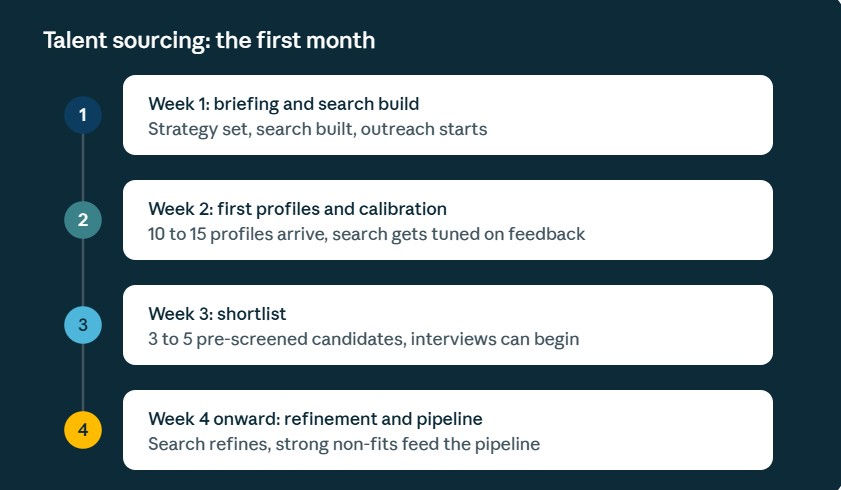
A realistic first-month timeline depends on seniority, market, location, language, compensation range, employer brand, and how quickly the hiring manager responds. The timeline below covers a mid-level role in an active European market. Niche recruitment, senior, confidential, and multi-country searches take longer and require more calibration.
1. Week One: Briefing and Search Build
The sourcing team needs to understand the role, the team, the deal-breakers, the markets in scope, potential talent pools, and which 2-3 companies have employees who would fit. By the end of week one, the talent sourcing strategy is created, the search is built, and outreach is starting.
2. Week Two: First profiles, Calibration
The first 10 to 15 candidate profiles arrive. The hiring manager reviews them and gives structured feedback, and the search adjusts. This round is the critical calibration phase, where the search gets tuned based on real candidate data rather than assumptions. Without fast, specific feedback, the sourcing team cannot tune the search with any precision. Vague feedback at week two means a bad shortlist at week four.
3. Week Three: Shortlist
Three to five qualified candidates, pre-screened, with summaries and current status. Interviews can begin immediately. Again, feedback is important.
4. Week Four Onward: Refinement and Pipeline
Interviews surface what worked and what didn't. The search refines. Candidates who weren't right for this role often stay relevant for the next one, which is how a real talent pipeline gets built over time. What I would emphasize most is that good sourcing is not a linear process where the brief is defined once, and candidates are simply delivered against it. In practice, it is iterative. The brief is tested against the market, the first profiles serve as calibration, feedback adjusts the search angle, and candidate response gives a real market signal back to the team.
How much does a talent sourcing service cost?
Compared to contingency agencies charging 15–25% of first-year salary per hire, a dedicated sourcing model converts unpredictable per-hire costs into volume-based pricing that scales in your favor. Savings vary by scope, role complexity, and geography.
Global Talent Sourcing: Case Study
When an international public sector organization underwent a major restructuring, it faced two problems at once: a hiring surge it couldn't handle with existing resources and the need to maintain diversity initiatives on a tight budget. Before the engagement, its recruitment function relied on a network of more than 35 recruitment agencies and headhunters for any sourcing beyond basic replacement hiring.
Serendi replaced that fragmented model with a dedicated talent pipelining program built around centralized sourcing. Within 9 weeks, the team had identified and approached more than 3,400 candidates across approximately 95 countries, using a team of sourcers covering 13 languages to reach talent across geographies the agency network had never accessed. Of those, 500+ were interviewed, and 230+ were shortlisted for the client's selection process.

The cost reduction on the restructuring project came to 71%. Geographic diversity (measured by countries represented in the shortlist) reached 101.
If your team needs this kind of support, sourcing delivers it.
The Talent Sourcing Process: Five Stages
The candidate sourcing process is structured around five activities.
1. Defining and Aligning
Clarify the role with the hiring manager: skills alignment, target industries, compensation reality, company culture, and which markets the search covers. For European mandates spanning multiple countries, language, data privacy,and GDPR questions get answered before the search starts.
2. Sourcing Candidates, Active and Passive
Build the search across the channels that match the role. The candidate sourcing methods that work for one role rarely work for another, which is why generic candidate sourcing techniques produce generic results. Most outreach efforts go into passive candidate sourcing because most of the best candidates fall in that group.
3. Candidate Screening and Qualification
Candidate screening confirms the candidate has the experience, is open to a move, and meets the practical constraints. One structured conversation is usually enough. Notes feed into the Applicant Tracking System (ATS), where candidate quality compounds over time.
4. Delivering the Candidate Shortlist
Three to five active candidates, pre-screened, with a summary and current status. Companies that get 20-name lists are buying market research, not a shortlist.
5. Optimizing and Reporting
Feed the data from each search back into the system and reevaluate sourcing strategies: which channels worked, which messaging got responses, which markets were tight. Without this loop, every new role starts from zero.

What Good Candidate Sourcing Looks Like (Do's and Don'ts)
Whether your sourcing is in-house or outsourced, the same patterns separate good outcomes from bad ones.
At the briefing stage
Do spend real time on the kick-off call. An hour of briefing saves a week of revised shortlists. A good brief covers the business context for the role, must-have versus nice-to-have criteria, deal-breakers, target companies, relevant industries, compensation reality, location flexibility, language requirements, expected seniority, and the reason a strong candidate would consider this opportunity in the first place. A rushed briefing is the single most common reason shortlists come back wrong.
Do name two or three companies whose employees would be a good match. Telling the sourcing team "we want someone who's done this job at Company A, B, or C" sharpens the search faster than any skills list.
Don't send the job description and expect that to be the brief. The JD is the marketing document. The brief is the actual hiring intent. They're rarely the same thing.
Don't describe the candidate as years in the business. "Five years of SaaS sales" matches thousands of people. "Sold to enterprise procurement teams in regulated industries" matches the right ones.
When the shortlist arrives
Do respond within two business days. Passive candidates lose interest fast, especially the ones worth hiring. Silence breaks candidate engagement faster than anything else, and it's the single most common reason good candidates drop out.
Do give structured feedback when you reject a candidate. "Not a fit" tells the sourcing team nothing. "Too generalist, we need someone who's owned the full P&L" tells them everything.
Do value the candidate relationships that come out of every search. Today's rejected candidate is often next year's strong fit, and consistent candidate outreach across roles compounds into a real pipeline.
Don't ask for more candidates before interviewing the ones you have. If the shortlist is wrong, the brief was wrong. More names will not fix the brief.
During the process
Do keep the interview loop short. The candidates worth hiring are usually being recruited elsewhere too. A four-week interview process loses more good people than a poor first conversation.
Do flag market signals back to the sourcing team. If three candidates told you the salary range is low, that's market data, not noise.
Don't add interview rounds halfway through because the team can't agree. If the brief was right, the bar was set at the briefing stage. Moving it mid-search is a sign to recalibrate, not to add steps.
What to expect from a talent sourcing partner
Do expect them to push back when the brief is unrealistic. A good sourcing service tells you when the market doesn't support what you're asking for. That's worth more than another round of unfocused profiles.
Do expect them to bring channel and market expertise you don't have in-house. The point of buying sourcing is to access knowledge of where candidates actually live, in markets where you don't operate every day.
The pattern across all of this: the better the brief and the faster the response loop, the more value you get.
Final Words on Candidate Sourcing
Done properly, talent sourcing is a strategic, structured, market-informed model for managing pipeline quality, not just another channel for finding candidates or a cheaper alternative to agencies.
One of my peers from another company recently had 500+ applications for his job posting. It turned out that almost 400 were from candidates living in other countries - and interested in remote roles. The job ad clearly stated that this was an in-office role.
Talent sourcing gives you something job ads can't: control over who gets into your hiring process.
There's a tempting argument that candidate sourcing only matters in tight markets. After all, when the economy slows down and layoffs hit, the candidates will come to you. Why pay someone to go find them?
The problem with that logic: loose markets don't produce better candidates, they produce more of them. Most of those applicants are people applying to anything that resembles their last job. And we can all agree that volume without precision is just more work.
Sourcing works in both directions. In tight markets, it reaches the people who aren't applying. In loose markets, it filters for the people who actually fit. Either way, you're not at the mercy of who happens to find your job ad.
If sourcing is the part of your hiring process that needs help, Serendi's talent sourcing service handles the work end to end across European markets.
Talent Sourcing: Frequently Asked Questions
What is talent sourcing?
Candidate sourcing is a talent acquisition strategy focused on identifying, attracting, and engaging professionals who match specific hiring criteria, especially passive candidates who are not actively job searching.
What are the benefits of talent sourcing?
Talent sourcing helps companies build stronger candidate pipelines, reduce time-to-hire, strengthen employer brand visibility, and reach qualified professionals who may never apply through job ads.
How long does talent sourcing take?
Time-to-shortlist depends on role complexity and market tightness. For mid-level roles in active European markets, a shortlist of three to five lands within two to four weeks of the brief. Niche or multi-country searches take longer. Proper talent sourcing is not a linear process in which the brief is defined once, and candidates are simply delivered against it. In practice, it is iterative. The brief gets tested against the market, early profiles calibrate the search, and candidate feedback reshapes the direction over time.
What is the difference between active and passive candidate sourcing?
Active sourcing targets people already seeking new roles, while passive sourcing focuses on qualified professionals who are not actively looking but can be recruited through outreach.
How does talent sourcing support talent management?
Talent sourcing strengthens talent management by building stronger candidate pipelines, improving workforce planning, reducing hiring delays, and helping organizations engage qualified professionals before talent shortages impact business operations.
What channels are used for sourcing candidates?
The main candidate sourcing channels are LinkedIn, role-specific platforms, employee referrals, and industry events. Sourcing talent through social media has become a core part of the function rather than a supplementary tactic, because most professionals maintain a presence on at least one professional platform.
Are employee referral programs part of talent sourcing?
Yes. Referral programs are one of the most effective sourcing channels because they help companies reach qualified passive candidates through trusted professional networks.
Can talent sourcing be automated?
Parts of it. Talent sourcing automation handles repetitive work like initial profile discovery, outreach drafting, and pipeline updates. The same applies to candidate sourcing automation. Modern sourcing solutions speed up early-funnel work, but qualification, judgment, and relationship-building still need humans.

About the author
Maja Kostadinovic is the Head of Strategic Enablement at Serendi.
She works at the intersection of recruitment strategy, delivery enablement, market insight, and operational improvement. She focuses on making complex recruitment environments more structured and transparent - from sourcing strategy and stakeholder alignment to KPI frameworks, reporting logic, HR technology adoption, and practical recommendations that help teams deliver better outcomes.

Expert Contributor
Julia Koblischke is the Head of Talent Solutions at Serendi.
Julia has over 8 years of cross-industry, international experience in talent acquisition and account management, advising our clients globally. Her passion lies in transparent communication, connecting people with the right opportunities, and helping companies achieve growth and success.