_2000px_RGB_pn.png)
Recruitment Marketing Strategy: How to Build a Candidate Pipeline That Converts

Updated: 5 minutes ago

About the author
Fiona-Sophie Grube is the Chief Development Officer at Serendi.
She builds on more than 20 years of experience in talent acquisition and recruitment with more than 25 international clients to set the framework for Serendi’s RPO delivery strategy and operations
In periods of economic uncertainty, investing in a recruitment marketing strategy is easy to deprioritize. But the last several years have shown that volatility is the new normal, and the demand for the right talent has not eased through any of it.
According to AIHR, companies that invest in recruitment marketing see a 3x increase in candidate quality. When conditions shift (as they always do), hiring needs spike before most organizations are ready.
Companies that continue to build their candidate pipelines during quiet periods will have an advantage. This guide covers how to build a strategy that works.
Recruitment Marketing Strategy: Key Takeaways
Recruitment marketing applies marketing principles to talent attraction: targeted campaigns, content, and channels that generate qualified candidate demand before and during hiring.
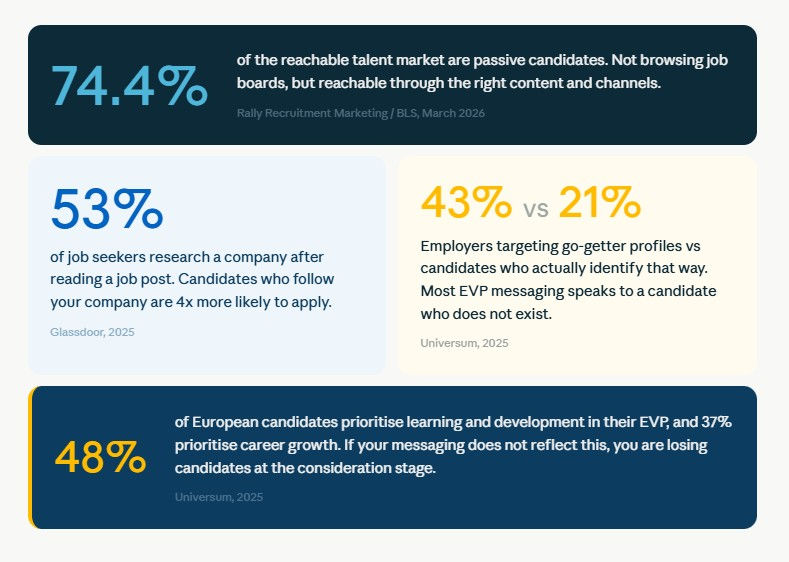
74.4% of the reachable talent market are passive candidates. A recruitment marketing strategy is the only systematic way to reach them.
Effective strategies are built on six foundations: defined talent profiles, role-specific EVP, deliberate channel mix, inbound and outbound in parallel, candidate journey design, and ATS integration.
Your EVP may be speaking to a candidate who doesn't exist. 43% of employers target ambitious, performance-driven profiles in their messaging, but only 21% of young professionals identify that way.
Only 44% of companies measure recruitment marketing ROI.
Employer branding and recruitment marketing are not the same thing. Branding defines who you are; recruitment marketing activates that brand to fill specific roles.
What Is Recruitment Marketing?
Recruitment marketing is the use of marketing strategies, campaigns, and channels to attract and engage qualified candidates before and during the recruitment process.
More specifically, it applies marketing principles to talent attraction, using targeted content and channels to reach potential candidates before they apply, and often before a role is even posted. Two distinctions are worth making clearly, because these terms get conflated constantly.
Employer Branding and Recruitment Marketing: What's the Difference?
Employer branding defines who you are as an employer: your values, culture, and employee value proposition. Recruitment marketing is how you activate that brand to generate applications for specific roles.
So, employer reputation is the foundation; recruitment marketing is the execution. The two are closely related but serve different purposes.
Employer branding tracks perception and awareness over time
Recruitment marketing tracks impression-to-application rates, applicant quality, and cost per qualified applicant.
You need both, but confusing them leads to campaigns built on unclear briefs and messaging that doesn't convert.
The Recruitment Marketing Funnel: How Candidates Move From Awareness to Application
Understanding the recruitment marketing funnel is essential for effective candidate attraction before building any strategy.
Candidates move through four stages:
Awareness: they encounter your employer brand for the first time
Interest: they engage more deeply with your company and roles
Consideration: they evaluate whether this role and the company are right for them
Application: they convert
Most companies invest almost entirely at the bottom of this funnel: the job posting itself. When roles are competitive, or candidates are passive, that alone recruitment-marketing-strategy-how-to-build-a-candidate-pipeline-that-convertsisn't enough.
According to data from the U.S. Bureau of Labor Statistics, analyzed by Rally Recruitment Marketing in early 2026, only 25.6% of the reachable talent market is actively looking or casually exploring opportunities. The remaining 74.4% are employed and passive: not browsing job boards, but reachable through the right content, messaging, and channels over time.
This passive majority is your largest untapped talent pool.
How to Build a Recruitment Marketing Strategy: A Step-by-Step Plan
A recruitment marketing strategy that works covers six things: target audience, EVP, channel mix, inbound and outbound activation, candidate journey, and measurement:
Step 1: Define Your Target Talent Profiles
Before any campaign is built, you need clarity on who you're trying to reach, and that answer differs by role. Most teams start by building candidate personas: structured profiles that map candidate interests, career motivations, and factors that would make someone consider a move.
What drives a senior data engineer is not what drives a regional sales manager, and campaigns built on that distinction perform significantly better than generic ones.
Start with your highest-priority or hardest-to-fill roles. For each, define the profile: skills, seniority, career stage, and likely current employer type. As you might expect, generic targeting produces generic results - and a shallow candidate pool.
Step 2: Clarify Your EVP by Role
Your Employee Value Proposition is not one message for everyone. A compelling EVP for a niche technical hire will emphasize different things than one aimed at a high-volume commercial role. That specificity needs to carry through to your job descriptions and how you address different target audiences across channels.
Here's where most companies get this wrong:
Universum's 2025 research across 736 talent leaders shows that 43% of employers target ambitious, performance-driven profiles in their EVP messaging. Yet only 21% of young professionals actually identify that way.
In fact, the largest self-identified group is balance seekers who prioritize work-life integration, yet just 7% of employers craft EVP messaging for that group.
In European markets specifically, learning and development (48%) and career growth opportunities (37%) top the list of what candidates actually want from an employer. If your messaging doesn't reflect this, you're likely losing candidates at the consideration stage.
Review role-specific messaging as part of your inclusive hiring practices, so job descriptions widen access without weakening the role's requirements.
Step 3: Choose Your Channel Mix
According to Universum's 2025 research, the top five channels where companies are increasing recruitment marketing investment are:
Social networks
Employer and career sites
Employee referral programs
In-person events
Professional networks
Another interesting data point is that 90% of recruitment marketing practitioners use social media to attract talent, up from 87% in 2023.
Recruitment channels should be selected by role, market, and candidate behavior: not by habit or contract. LinkedIn is not automatically the right choice for every hire.
For instance, niche communities, programmatic job boards, professional networks, social media platforms, and in-person job fairs each reach different target audiences at different stages of the recruitment funnel.
Programmatic recruitment marketing, where job ad spend is distributed and optimized automatically based on performance data, is particularly effective for roles with higher volume or geographic spread. Combined with social media marketing and targeted social media campaigns, it forms the basis of true multi-channel campaigns that reach passive and active candidates across touchpoints.
Universum's data shows that 42% of talent leaders plan to increase investment in social networks and 40% in employer career sites: the shift is toward owned and measurable channels, away from broad third-party spend.
Step 4: Build Inbound Recruitment Marketing Alongside Outbound Campaigns
Outbound generates immediate attention: paid campaigns, targeted ads, direct outreach. But inbound recruitment marketing compounds over time and significantly reduces cost per applicant.
Inbound includes your career site and job listings, SEO-optimized job content, content marketing, employee stories and testimonials, talent communities where candidates gather around topics and roles, employee referral programs, thought leadership, and email marketing to talent who have engaged with your brand.
According to Glassdoor's 2025 research, 53% of job seekers look for more company information after reading a job post, and candidates who follow your company are almost four times more likely to apply. Also, over 60% of Gen Z candidates trust referrals more than any other recruiting method.
The most effective recruitment marketing strategies run inbound and outbound in parallel. Outbound generates an immediate talent pipeline; inbound builds long-term visibility and candidate engagement.
Step 5: Design the Candidate Journey to Reduce Drop-Off
The candidate experience between initial engagement and the completed application is where most talent pipelines quietly lose ground. Drop-off is often higher than teams realize, and most of it is avoidable.
From our experience and candidate conversations, we can say that application friction is one of the most important reasons: forms that are too long, career pages that don't load on mobile, and no acknowledgment after applying.
Organizations shouldn’t view these as small UX issues, but pipeline leaks that undermine everything upstream. The best course of action is to map the candidate journey for each role type and test it yourself - just like a candidate would.
There is a recruitment trend worth addressing because it is worsening. Ghosting (on both sides) has become one of the most damaging forces in talent acquisition today.
Employer ghosting has more than doubled since 2020. According to Resume Genius, 8 out of 10 hiring managers admit to ghosting candidates. Candidates are responding in kind: candidate ghosting has climbed from 37% in 2019 to 62% in 2024.
This is more than a communication breakdown. It reflects a deeper shift in how employers and candidates engage with each other.
Employer ghosting has a direct cost to the employer brand.
Candidates talk.
In niche talent markets, especially, professional communities are tight, and a single bad experience travels fast. The damage is not always visible immediately, but it compounds.
Why do candidates reject offers?
Find out more in our article: Why Job Candidates Are Saying No: The Top Reasons Behind Rejected Offers
Step 6: Integrate With Your ATS From Day One
Recruitment marketing without ATS integration can be described as flying blind. If campaign data doesn't flow into your hiring workflow, you lose the ability to connect spend to outcomes. You won't know which channel produced a qualified applicant, which message drove the best conversion rate, and which campaign contributed to an actual hire. Build this connection before campaigns go live, not as an afterthought.

Recruitment Marketing Examples: What Good Looks Like in Practice
The three examples below are drawn from Serendi's work with clients across Europe.
1. Ultra-Niche Technical Hiring
A global leader in navigational systems needed to build R&D teams across five European countries. For several roles, there were an estimated 30 to 40 qualified professionals worldwide. Standard job postings were pointless. The approach shifted to relationship-based recruitment marketing: deep market mapping, personalized outreach anchored in the technical substance of the work, and pipeline-building that started months before roles opened.
Result: 55% reduction in recruitment costs, 40% reduction in time-to-hire, and successful placements across all five locations.
2. High-Volume Greenfield
An automotive supplier needed to hire 1,700 staff across four years at a new manufacturing facility, with no existing employer brand presence in the region. Talent pools of 25,000 blue-collar and 1,300 white-collar profiles were built through recruitment marketing, targeted talent sourcing, and community engagement.
Outcome: The employer brand work translated into a ranking in the top 2% of companies in a regional employer attractiveness survey and an average candidate satisfaction of 5.0 out of 6. All hires were delivered on schedule.
3. Multi-Market Standardization
A Swiss pharmaceutical company with operations across EMEA had no consistent recruitment process, and HRBPs were buried in admin. Recruitment marketing and talent acquisition were standardized across the region.
Outcome: hiring manager satisfaction of 5.3 out of 6, 98% reporting completeness, 91% process compliance on audit.
Recruitment Marketing Metrics, Analytics, and ROI: What to Actually Measure
The performance metrics most often reported, such as impressions, clicks, and total applicants, are inputs. They tell you about activity, not outcomes. A recruitment marketing strategy should be measured by what it produces for the business.
Five metrics that actually matter in recruitment marketing:
Impression-to-application rate: measures how well your messaging and targeting are working together
Application completion rate: the proportion of candidates who start an application and finish it. This is a direct signal of friction in the candidate experience
Applicant quality rate: the proportion of applicants who progressed to an interview by the hiring team
Cost per qualified applicant: not cost per applicant. Dividing the spend by total applicants inflates the number with irrelevant submissions. (especially important in these days when candidates use AI tools to auto-apply to jobs)
Time-to-pipeline: how quickly a campaign generates a workable shortlist
Universum's research found that only 44% of companies measure the ROI of their recruitment marketing efforts. Among the world's most attractive employers, that figure is 61%.
If you can't track these metrics, recruitment marketing spend is permanently vulnerable to cuts because nobody can prove it's working.
Read more about recruitment KPIs.
How to Improve Your Recruitment Marketing
The most common failure mode isn't budget: it's that the fundamentals haven't been connected.
1. Check Your EVP
Check whether your EVP messaging is still accurate. Only 52% of companies have updated theirs in the last two years, and outdated messaging creates misaligned expectations.
2. Audit Your Recruitment Marketing Campaign Performance Regularly
Build a regular audit cycle: review impression-to-application rates by channel, compare applicant quality across sources, and check where candidates are dropping off. Consistent, data-driven iteration compounds results over successive hiring cycles. Among the world's most attractive employers, recruitment marketing budgets have grown 46% since 2022, not by spending more broadly, but by measuring what works.
3. Adapt Your Recruitment Strategy for the AI Era
Channel strategy is shifting because of how candidates search. As of mid-2025, 40.7% of candidates reported using AI tools in their job search, up from 17.3% in 2024.
A growing share are using dedicated AI job search tools that scan job boards, match roles, and submit applications in bulk. Others use LLMs to research employers and decide where to apply, often without ever visiting a career site.
The direction of travel is clear. As Maria Christopoulos Katris, CEO of Built In, put it at Talent Acquisition Week in February 2026: "Think of a world where, in five years, candidates are starting and stopping their search in the LLMs. You should assume they are starting their search, they're identifying companies to work for, they're researching you, and they're making decisions, all without leaving an LLM."
This creates two problems worth preparing for.
Problem No. 1: Volume
Gartner predicts that by 2028, 1 in 4 candidate profiles worldwide will be fake, partially or entirely fabricated using generative AI.
But even legitimate AI-assisted applications inflate the noise. The business model of AI job search tools is built on volume: the more applications submitted, the more value they demonstrate to the candidate. Whether those applications are a good fit is secondary.
The result is a world where candidates' AI tools flood inboxes, and companies' AI tools try to filter them out. Recruitment teams are caught in the middle, spending more time screening and less time hiring.
Problem No. 2: Visibility
If candidates are making decisions inside LLMs without visiting your career site, your recruitment marketing content needs to be structured so AI can read, cite, and surface it. Clear answers, consistent employer brand information across owned and third-party sources, and a strong reputation on platforms LLMs scan (Glassdoor, LinkedIn, industry forums) now determine whether your company appears when a candidate asks an AI which employer to consider.
When to Build In-House vs. When to Use Recruitment Marketing Services
In-house makes sense when you have a dedicated resource, stable hiring volumes, a well-defined employer brand, and visibility into what's working.
The case for an external partner is strongest when those conditions aren't met. For instance:
niche or specialist roles where generic campaigns won't reach the right audience; rapid scaling across markets or regions;
fragmented employer brand;
campaigns generating applications, but not the right ones. (again, AI tools used by candidates)
Recruitment marketing works when it's treated as a system: defined audiences, role-specific messaging, deliberate channel selection, and continuous measurement.
Without that structure, most of the spending and effort generate noise rather than a pipeline.
Recruitment marketing partners bring channel expertise and measurement infrastructure that most in-house teams take years to build.
Serendi's recruitment marketing service helps organizations build the candidate pipeline their hiring teams actually need, from brand visibility to qualified applicants.
60% of our team are psychologists and 20% specialise in behavioral science. Combined with dedicated recruitment coordinators managing every candidate interaction, we build recruitment marketing strategies that attract the right people and keep them engaged through the process.
Recruitment Marketing Strategy: Frequently Asked Questions
What is a recruitment marketing strategy?
A recruitment marketing strategy is a plan for attracting qualified candidates through marketing before and during the hiring process. It applies marketing principles to talent acquisition: defining who you're trying to reach, how you'll reach them, what message will resonate, and how you'll measure results.
How is recruitment marketing different from employer branding?
Employer branding defines who you are as an employer; recruitment marketing is how you communicate that to attract candidates for specific roles. Employer branding covers your values, culture, and employee value proposition. Recruitment marketing activates that brand through campaigns aimed at specific audiences. Branding is long-term and broad; recruitment marketing is campaign-driven and outcome-focused.
How long does it take for a recruitment marketing strategy to show results?
Most recruitment marketing strategies show early signals within two to four weeks and meaningful talent pipeline impact within one to three months. Traffic, click-through rates, and application volume are the first indicators. Deeper hiring impact follows as pipelines mature and campaigns are optimized across cycles.
What channels are used in recruitment marketing campaigns?
The channels used in recruitment marketing campaigns vary by role and target audience, but typically include LinkedIn, programmatic job boards, niche professional communities, social media platforms, email marketing, and dedicated landing pages. Performance data should drive the mix, not assumptions or habits.
How do you measure the success of a recruitment marketing strategy?
The success of a recruitment marketing strategy is best measured by applicant quality rate, cost per qualified applicant, impression-to-application conversion, and time-to-pipeline. These connect marketing activity directly to hiring outcomes, unlike vanity metrics such as impressions or total clicks. Measuring effectively requires ATS integration from the start, so campaign data can be traced through to hire.
Sources
Rally Recruitment Marketing / U.S. Bureau of Labor Statistics, Rally ReachMap,


