_2000px_RGB_pn.png)
How a Structured Role Intake Changes Recruitment Outcomes

Updated: Sep 3
A hiring manager may have a clear picture of the person they want to hire. The market may tell a slightly different story.
Recruitment issues usually appear gradually: in the first shortlist, in candidate feedback, in salary conversations, or when the hiring manager realizes that the written brief does not fully match the person they had in mind.
That is where a structured role intake proves its importance.
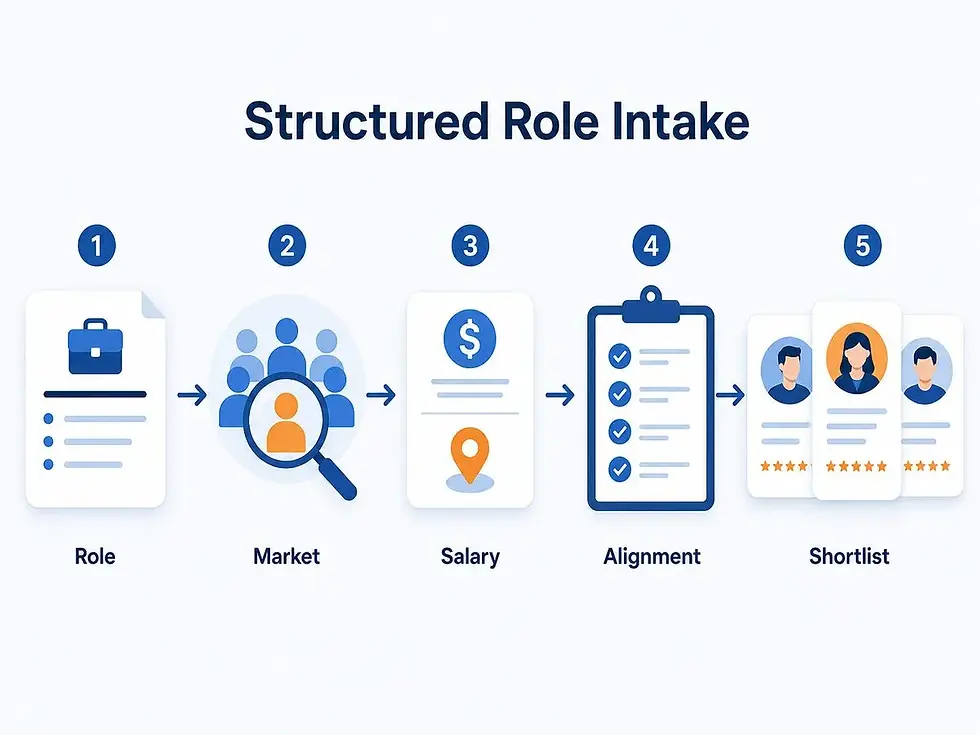
Before sourcing starts, the intake helps the recruiter and hiring team test the role against the market: candidate availability, salary expectations, location limits, seniority, and what would actually motivate candidates to move.
That is why intake is not just an initial step but one of the most important parts of recruiting as a service and RPO models.
What Is a Structured Role Intake?
A structured role intake is the alignment step before sourcing begins.
It is usually a scheduled conversation between the recruiter, the hiring manager, and sometimes HR or the internal talent acquisition team. The goal is to move beyond the job description and understand the role as it will be worked in the market.
A job description gives the formal version of the role. A role intake gives the practical version.
It clarifies why the role is open, what the person will actually do, which skills are essential, which requirements can be adjusted, how the salary range fits the market, and what kind of candidate is most likely to respond.
It also covers the process around the hire: who gives feedback, how quickly interviews can happen, who makes the final decision, and what would create hesitation.
These details can feel operational, but they shape the search from day one. They also shape candidate messaging.
Candidates respond to reasons, not only requirements, especially when they are not actively looking. Intake helps define why someone would consider the role, and where the offer has constraints that should be clear from the start.
Job Description Is Only the Starting Point
Most job descriptions are written for approval, posting, or internal consistency. They have to satisfy several internal needs before they ever reach a candidate.
That does not always make them strong sourcing briefs.
In practice, a job description may include helpful but non-essential requirements, describe a level of seniority that does not match the salary range, or stay unclear on what the hiring manager will value most when candidates arrive.
A structured role intake gives the recruiter space to ask the questions that make the brief usable. Which skills matter from day one? Which can be trained? Is the compensation strong enough for the candidate pool? Are adjacent backgrounds worth considering? What would make someone leave their current role for this one?
It is a mistake to think that those questions slow the search down. In fact, they reduce the chance that talent sourcing starts in a direction the hiring team later decides is wrong.
How Role Intake Improves Shortlists and Reduces Rework
A shortlist is useful only if it reflects the real hiring decision.
That is why structured role intake matters before sourcing starts. It gives the recruiter clearer criteria, and it gives the hiring manager a shared reference point when candidates are presented.
Without that shared reference point, feedback can become too general. “Not quite right” is common, but it does not help much unless everyone understands what was missing.
A structured intake makes the feedback loop easier. If a candidate has the right skills but the wrong industry background, the search can adjust. If the salary range is limiting the pool, the team can decide whether to review compensation, widen the profile, or accept a longer search.
If a requirement keeps appearing in feedback but was not part of the original brief, it can be discussed properly instead of emerging one candidate at a time.
This reduces rework.
The recruiter spends less time sourcing against assumptions, and the hiring manager spends less time rejecting profiles that were never likely to work. Also, candidates get a clearer picture of the role earlier in the process.
In Serendi’s delivery model, candidate presentation is built around screened shortlists, not volume for its own sake. Across Serendi programs, 53% of presented candidates reach the interview stage, 96% of client offers are accepted, and 98.6% of placed candidates pass probation.
Those outcomes depend on sourcing and screening, but they also depend on the clarity created before sourcing starts.
A good intake also makes the recruitment model easier to choose. If the need is one role, several roles, or a wider recruitment program, the right setup will not be the same. We analyze it in Recruitment as a Service vs Agency vs RPO.
Where Talent Market Insights Help
A structured role intake can work without a full market report. For straightforward roles, a clear conversation between the hiring manager, HR, and recruiter may be enough to set the search direction.
For more complex hiring, that conversation benefits from evidence.
This is where Talent Market Insights come in. In Serendi Flex, they are included in the Grow and Scale packages as an added layer around intake. The purpose is not to make the process heavier. It is to give the hiring team a clearer view of what the market can support before sourcing starts.
That can include candidate pool size, salary benchmarks, competing employers, location constraints, candidate availability, and likely time-to-hire.
Role intake can otherwise become a discussion of internal preferences. Talent Market Insights add the external check: how realistic is this brief in the market right now?
And even when reality is not what we hoped for, in business, it is still what we have to work with.
If the talent pool is narrow, the team can decide whether to widen the profile. If compensation is below market, that can be discussed before candidates reach the offer stage. If the role offers stronger flexibility, scope, or growth potential than competitors, that becomes part of the outreach message.
What a Good Intake Requires From the Client
A good intake is a working conversation. The client does not need to have every answer perfectly prepared, but the recruiter does need enough context to understand the role, the team, and the decision process.
The most useful inputs are straightforward: a clear hiring owner, a realistic salary range, must-have criteria, flexible criteria, interview steps, feedback timing, and role priority.
In a recruitment subscription model, this is especially important because each role uses paid capacity. The intake credit should start work on a role that is clear enough to search, not a role that still needs to be discovered through repeated rejections.
You can read more about costs in our article: Recruitment as a Service: Pricing Explained
The Link Between Intake and Hiring Outcomes
Structured role intake improves hiring outcomes by building a stronger foundation for talent sourcing.
It helps the team clarify the profile, test the market, shape candidate messaging, understand likely trade-offs, and agree on how candidates will be evaluated.
A stronger search starts before the first candidate is contacted.
Frequently Asked Questions About Structured Role Intakes
What is a role intake in recruitment?
A role intake is the alignment step before sourcing starts. The recruiter and hiring stakeholders clarify the role, requirements, salary range, candidate profile, market conditions, and process expectations.
Who should join the role intake meeting?
The hiring manager should join, along with the recruiter or Talent Acquisition Partner. HR or internal talent acquisition should also be involved when they own compensation, process, or stakeholder alignment.
What questions should be asked in a recruitment intake?
A good intake should cover why the role is open, required skills, flexible criteria, salary range, location, target candidate backgrounds, candidate motivation, interview steps, feedback timing, and likely hiring risks.
Is role intake part of a Recruitment as a Service model?
Yes. In a Recruitment as a Service model, each activated role should start with a structured intake. This helps turn the intake credit into a focused search rather than a broad sourcing request.

About the author
Julia Koblischke is the Head of Talent Solutions at Serendi.
Julia has over 8 years of cross-industry, international experience in talent acquisition and account management, advising our clients globally. Her passion lies in transparent communication, connecting people with the right opportunities, and helping companies achieve growth and success.

