_2000px_RGB_pn.png)
What Is Recruitment Process Outsourcing? A Definition of RPO

Updated: 1 day ago
Few business decisions matter more than who you hire.
The problem is that some of the most important hiring decisions have to be made when conditions are far from ideal.
There are plenty of hiring playbooks for that perfect scenario. But how often does it really happen?
The role may be urgent. The talent pool may be tiny. Hiring managers may be stretched. You may be entering a market your team barely knows.
Recruitment Process Outsourcing (RPO) gives employers another way to manage that complexity by transferring responsibility for an agreed part, or all, of the recruitment process to an external specialist.
From here, we'll look at what RPO is, when it works best, how it differs from other recruitment models, and what employers can expect from it.
What Is Recruitment Process Outsourcing? Key Takeaways
Recruitment Process Outsourcing (RPO) means transferring part or all of your recruitment process to an external provider.
The defining feature is process responsibility. An RPO provider manages an agreed recruitment scope rather than simply supplying candidates for individual vacancies.
RPO can cover selected recruitment activities or an end-to-end hiring process.
Common models include End-to-End RPO, Hybrid RPO, Project RPO, and On-Demand RPO.
RPO pricing can be transactional, retainer-based, FTE-based, or a combination of fixed and variable fees. In Serendi's End-to-End RPO comparison, average cost per hire is €4,500, compared with €8,000 for contingency agencies and €5,900 for traditional in-house recruitment.
Based on Serendi's practical experience, RPO typically starts to make economic sense at around 30+ hires per year, although the actual break-even point depends on role complexity, existing agency costs, geography, and the scope of the engagement.
Recruitment Process Outsourcing Definition: What Is an RPO?
Recruitment Process Outsourcing (RPO) is a delivery model in which an employer transfers responsibility for all or part of its recruitment process to an external provider.
RPO does not automatically mean handing your entire Talent Acquisition function to another company. An RPO provider may manage the complete recruitment lifecycle, hiring in one region, particular job families, a defined recruitment project, or selected stages of the recruitment process.
In more integrated RPO models, dedicated recruiters work as an extension of the client's Talent Acquisition team and broader human resources function. Through an embedded and centralized delivery model, they build direct knowledge of the company's culture, working environment, hiring managers, employer value proposition, employer branding priorities, and communication style.
That context helps them represent the company more accurately and support a more consistent candidate experience. For companies considering recruitment outsourcing, process ownership and integration are useful ways to distinguish RPO from other forms of external recruitment support.
How Does Recruitment Process Outsourcing Work?
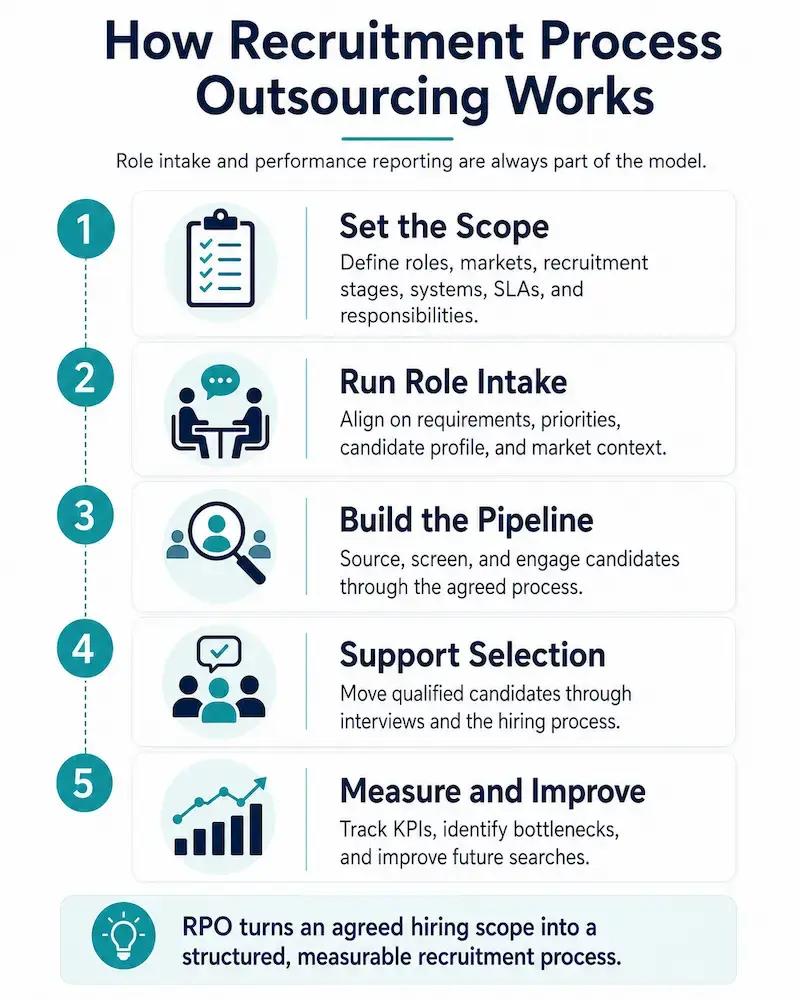
Recruitment process outsourcing works by turning an agreed recruitment scope into an operating model. The employer and RPO provider define responsibilities and service levels, connect the RPO team to the company's hiring process and systems, and then manage recruitment delivery against agreed performance measures.
Recruitment process outsourcing process:
1. Scope Becomes an Operating Plan
Once the company decides what to outsource, the RPO provider translates that scope into practical responsibilities. This includes who owns sourcing, candidate screening, interviews, offers, and administration; which decisions stay with hiring managers; expected service levels; reporting; and how the teams will work together.
2. The RPO Team Runs Day-to-Day Recruitment
The RPO team works within the agreed process. They can bring their own or use the client's applicant tracking systems, recruitment technology, and automation tools. Depending on the scope, delivery can include direct sourcing, recruitment marketing, building talent pipelines, resume screening, candidate engagement, interview coordination, offer support, and onboarding candidates. Hiring managers remain responsible for the hiring decision. The RPO team manages the recruitment work needed to get qualified candidates to that point.
3. Delivery Is Measured and Adjusted
Performance is tracked against agreed recruitment KPIs, such as time-to-present, time-to-hire, time-to-fill, conversion rates, hiring manager satisfaction, and quality of hire. As the same team works across multiple roles and searches, it can also build market insight and use what it learns about candidate availability, sourcing channels, and process bottlenecks to adjust delivery.
RPO vs Staffing Agency: What Is the Difference?
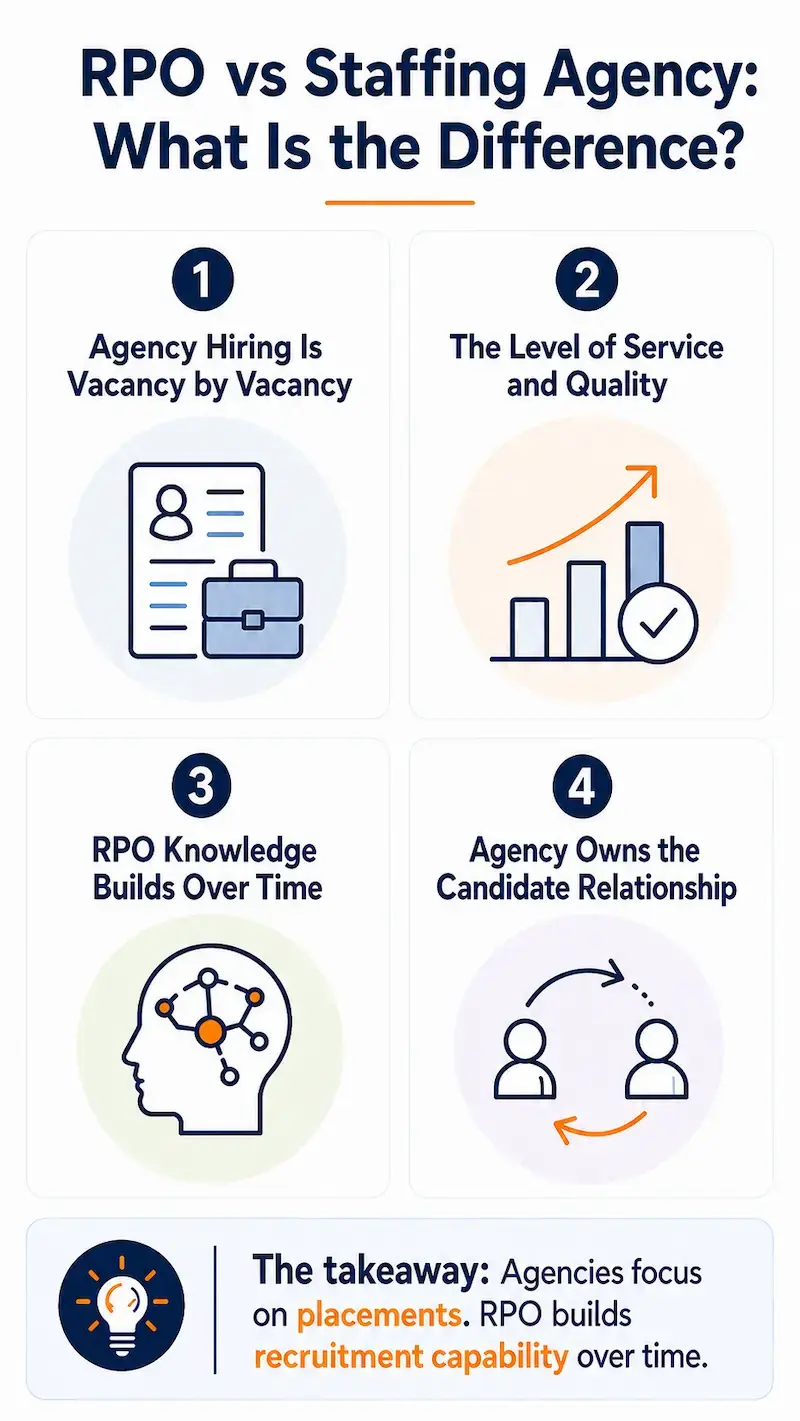
A staffing agency typically fills individual vacancies and earns a fee for successful placements. An RPO provider takes responsibility for an agreed recruitment process across multiple roles, teams, locations, or hiring stages.
1. Agency Hiring Is Vacancy by Vacancy
A recruitment agency usually works role by role. You open a vacancy, the agency searches, and you pay a fee when someone is hired. For occasional or specialist hires, that can work well. As hiring becomes continuous, the economics change.
With an agency, recruitment is effectively purchased again with every placement. RPO spreads recruitment capability across a broader hiring program, reusing processes, sourcing capacity, talent pipelines, reporting, and market knowledge.
2. The Level of Service and Quality
An agency is primarily rewarded for making a placement. An RPO provider can be accountable for wider recruitment performance, including pipeline health, conversion, time-to-hire, process consistency, and cost per hire.
3. RPO Knowledge Builds Over Time
With a recruitment agency, there is little to no knowledge transfer. An embedded RPO recruiter works with the organization over time, learning hiring managers, culture, EVP, communication style, and what successful candidates look like. That knowledge carries into the next vacancy.
4. Who Owns the Candidate Relationship
In a traditional agency model, the recruiter usually retains the primary relationship with the candidate because that relationship is a commercial asset. The agency may stay connected after placement and work with the same person again on future moves, creating opportunities for repeat placements.
With embedded RPO, the relationship is built under the employer brand instead, strengthening the company’s own talent network and candidate loyalty.
Many of these concerns say more about provider choice than about RPO itself. See our full breakdown of the most common concerns and misconceptions about RPO.
What Changes for a Hiring Manager
From a hiring manager’s perspective, RPO creates a more continuous recruitment relationship. Instead of briefing a new external recruiter for each search, the same team can retain knowledge of the role, business, culture, and hiring expectations across multiple hires.
As a hiring manager | In-house | Agency | RPO |
Who do you work with? | Internal TA team | External agency recruiter | Dedicated RPO team |
Role intake & context | Recruiter already knows the business | You brief the agency for each search | RPO recruiter builds knowledge across roles, teams, culture, and EVP |
Finding candidates | Internal team sources within its capacity | Agency sources for individual vacancies | RPO owns sourcing and screening across the agreed scope |
Candidate communication | Under your employer brand | Usually through the agency | Can be managed under your employer brand |
Interview & admin support | Usually handled internally | Often remains with your team | Can be managed by the RPO team |
With RPO, the provider can take responsibility for the wider workflow while you focus on role requirements, candidate assessment, and the final hiring decision.
What Kinds of RPO Models Are There?
The main RPO models are End-to-End RPO, Hybrid RPO, Project RPO, and On-Demand RPO. They differ mainly in how much of the recruitment process the provider owns, how long the engagement lasts, and how closely the RPO team works with the client's internal Talent Acquisition function. These engagement models can be broad or highly targeted.
● End-to-End RPO
End-to-End RPO gives the provider responsibility for the full recruitment lifecycle within an agreed scope, potentially from workforce planning and role intake through sourcing, selection, offer management, and onboarding support. Read more in our End-to-End RPO guide.
● Hybrid RPO
Hybrid RPO combines an internal Talent Acquisition team with an external RPO team. Responsibilities can be divided by geography, job family, business unit, recruitment stage, or another defined scope. Modular RPO frees the internal team to focus on strategic hiring while external specialists own defined delivery areas.
● Project RPO
Project RPO is built around a defined hiring objective and timeframe. It can support a market entry, new site, product launch, high-volume hiring ramp-up, or another temporary recruitment requirement.
● On-Demand RPO
On-Demand RPO provides recruitment capacity that can be activated when hiring demand increases and reduced when it falls.
Our full guide to RPO delivery models compares the models in more detail and explains where each tends to fit.
What Does Recruitment Process Outsourcing Look Like in Practice?
In practice, RPO can mean managing hundreds of hires, taking over only part of recruitment, or helping fill highly specialized roles with very limited talent pools.
The five recruitment process outsourcing examples below are separate Serendi engagements. Every result and performance figure applies only to the named engagement and should not be interpreted as a general RPO benchmark.
1. SITA: From 30 Cybersecurity Roles to 400 Technology Hires
SITA initially brought Serendi in for around 30 cybersecurity roles. The scope later expanded across the wider CTO technology organization, turning a focused hiring requirement into a much broader recruitment partnership.
In this SITA engagement, Serendi delivered 400 hires across 13 countries, with an average time-to-hire of 47 workdays and a 96% offer acceptance rate.
Read the SITA RPO case study.
2. Ferring: Embedded End-to-End RPO Across Two Countries
Ferring needed a dedicated Talent Acquisition function to support expansion across Switzerland and Germany. Serendi deployed embedded recruiters in Saint-Prex and Kiel, operating under Ferring's brand and working through its recruitment systems. The recruiters worked closely enough with the business to understand its teams, culture, hiring managers, and EVP, then carried that context into candidate conversations.
For this Ferring engagement, 753 hires were delivered, with a 94% offer acceptance rate, 5.2/6 hiring manager satisfaction, and an average of 9 workdays to the first candidate shortlist.
Read the Ferring case study.
The program also shows why a regional operating model still needs local recruitment strategies. Our analysis of recruitment trends in the DACH region explains how hiring conditions differ across Germany, Austria, and Switzerland.
3. LNDS: Outsourcing Only Part of Talent Acquisition
LNDS did not outsource its entire hiring function. It handed Serendi defined responsibilities, including requisition management, job posting, candidate sourcing, candidate selection, and interview scheduling. The dedicated team also spent time with LNDS in Luxembourg to understand the working environment and culture before representing the organization to candidates.
During this specific LNDS engagement, 20 people were hired within six months. Read the LNDS story.
4. Project RPO: 70 Specialist Roles Across Europe
A food processing solutions company needed to support new business lines across several European markets. Serendi deployed a dedicated Project RPO team combining recruiters, sourcing specialists, and recruitment coordination.
Across this six-month Project RPO engagement, approximately 70 positions were filled, a talent pool of 4,800 candidates was built, time-to-hire decreased by 29 days, and the project finished with zero aging positions.
Read the Project RPO case study.
5. Ultra-Niche RPO: When Only 30-40 Suitable Profiles Exist Worldwide
For a navigation technology company expanding its R&D teams across Europe, some specialist roles had only 30-40 suitable professionals worldwide. Serendi combined targeted sourcing, talent market intelligence, and close hiring manager alignment to work within that unusually small talent pool.
For this specific niche-hiring engagement, recruitment costs were reduced by 55% and time-to-hire by 40%. These figures describe this engagement only.
Read the niche talent case study.
What Can Recruitment Outsourcing Improve?
RPO can improve recruitment capacity, access to talent, quality of hire, candidate experience, scalability, and visibility. It can also simplify cross-border recruitment by giving employers one coordinated delivery model across markets instead of relying on numerous local agencies.
The main benefits include:
More recruitment capacity: A dedicated RPO team adds delivery resources without requiring a permanent increase in internal recruitment headcount.
Better access to talent: Direct and strategic sourcing can reach passive and hard-to-find candidates, early talent, activate global talent communities and build stronger talent pipelines.
Simpler cross-border recruitment: One RPO partner can coordinate recruitment across multiple countries in Europe, reducing the need to manage numerous local agencies, separate processes, and fragmented reporting.
Better talent intelligence: RPO teams build market insight across roles, geographies, and industries, helping employers understand talent availability, salary expectations, competitor activity, skills shortages, and candidate mobility before making hiring decisions.
Higher quality of hire: Structured sourcing, screening, and hiring-manager alignment can improve candidate matching. Across Serendi recruitment delivery, 95% of placed hires pass probation.
More scalable recruitment capacity: Recruitment resources can expand for hiring surges, difficult niche roles, new projects, or geographic expansion, and scale back when demand changes.
More time for internal TA and hiring managers: The RPO team can own sourcing, screening, coordination, and other agreed activities while internal teams focus on strategic priorities and hiring decisions.
More consistent candidate experience: Embedded recruiters can work under your employer brand, using consistent communication and processes across the candidate journey.
Better recruitment visibility: Defined KPIs and recurring delivery across roles make it easier to identify bottlenecks, candidate availability, sourcing performance, and other market insights that can improve future hiring.
For a full breakdown, see Why Outsource Recruitment?
How Much Does Recruitment Process Outsourcing Cost?
Recruitment process outsourcing cost depends on hiring volume, service scope, geography, team structure, and level of integration. Serendi's practical rule of thumb is that RPO typically starts to make economic sense at around 30 or more hires per year.
In a separate Serendi TCO model, based on 15 years of delivery data combined with industry research, a 500-employee company making 80 hires annually reached the modeled break-even point at 41 hires. Neither figure is a universal RPO benchmark.
There is no single recruitment process outsourcing pricing model. RPO can be priced transactionally, through a retainer or FTE-based model, or through a combination of fixed and variable components.
Serendi's End-to-End RPO comparison also shows how the models can differ in direct cost of hiring and speed:
Metric | End-to-End RPO | Contingency agencies | Traditional in-house |
Cost per hire | €4,500 | €8,000 | €5,900* |
Time-to-hire | 37 days | 42 days | 63 days |
You can find a detailed recruitment cost analysis here: RPO cost vs in-house recruitment analysis.
*The in-house cost is calculated using Serendi's TCO framework and includes direct visible costs only, not including the invisible costs of in-house recruitment. The comparison uses three-year averages from Serendi projects together with industry benchmarks across different industries and regions, so these figures should be treated as an illustrative comparison rather than a universal benchmark.
The 30+ hires per year figure is practical guidance, while the 41-hire break-even point comes from an illustrative worked example in our detailed cost analysis we mentioned above. The actual threshold depends on role complexity, agency usage, internal recruitment costs, geography, hiring consistency, and the scope transferred to the RPO provider.
When Does Outsourcing Recruitment Make Sense?
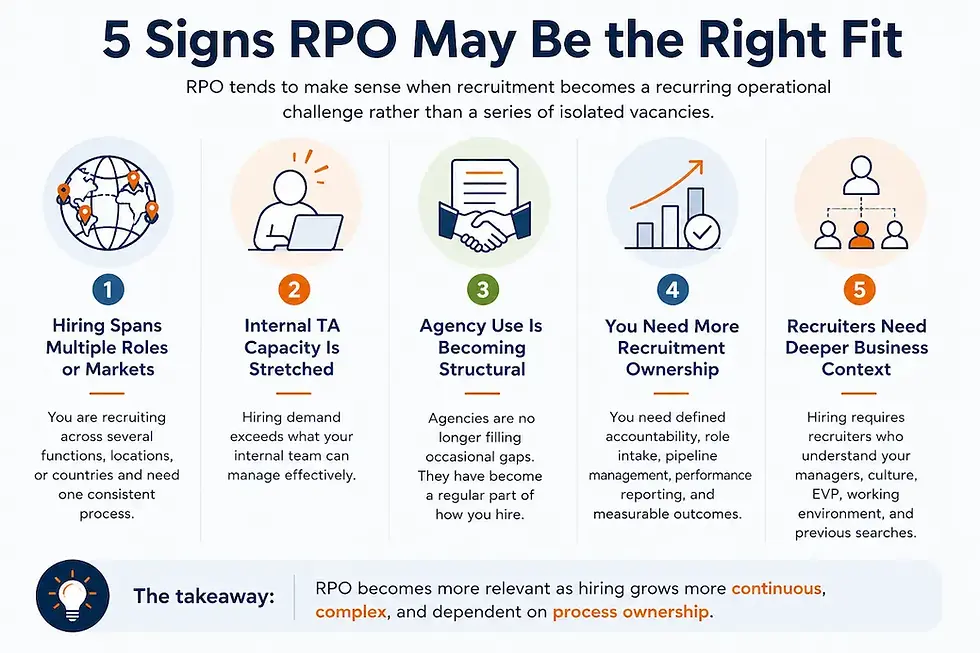
RPO is most relevant when hiring demand spans multiple roles, markets, or business units, internal recruitment capacity is constrained, or the company needs consistent process ownership and measurable recruitment performance. Recruitment process outsourcing is worth considering when you:
hire continuously across multiple roles;
enter markets where your internal team has limited recruitment capability;
depend heavily on agencies or need more sourcing capacity;
need a consistent hiring process across countries or business units;
need recruitment capacity to increase or decrease with demand;
want clearer ownership and measurable recruitment performance.
Hiring volume is only part of the decision. RPO can also make sense for a smaller number of hard-to-fill roles, especially across several markets.
The case becomes stronger when you also need deeper integration, such as embedded recruiters, system access, customized processes, or long-term ownership.
If you need more structure than a contingency agency but less commitment than full-cycle RPO, a recruitment subscription can provide a middle ground. Serendi Flex uses predefined service levels, a standardized delivery model, and shorter subscription-based commitments. See our comparison of Recruitment as a Service vs Agency vs RPO.
The point is to match hiring solutions to the problem you actually have. For more guides and analysis, explore our RPO insights.
Recruiting Process Outsourcing: Next Steps
If you are trying to work out whether recruitment outsourcing is for you and which RPO model makes sense for your hiring needs, we would be happy to look at the challenge with you. You do not need to have the delivery model figured out first. Start with the roles, locations, hiring volume, and what is currently not working, and we can take it from there.
We have more than 15 years of experience delivering RPO programs across different markets and hiring challenges.
Our work has recently been recognized in the Everest Group 2026 RPO PEAK Matrix® Assessment for India, the Everest Group 2025 RPO PEAK Matrix® Assessment for EMEA, and HRO Today’s 2026 Baker’s Dozen Customer Satisfaction Ratings, where Serendi was included among the top RPO providers for midsize deals.

About the author
Fiona-Sophie Grube is the Chief Development Officer at Serendi
She builds on more than 20 years of experience in talent acquisition and recruitment with more than 25 international clients to set the framework for Serendi’s RPO delivery strategy and operations.
What Is Recruitment Process Outsourcing? Frequently Asked Questions
What Is Outsourcing in Recruitment?
Recruitment outsourcing means assigning part or all of your recruitment activities to an external provider. The scope can range from sourcing or screening to a broader RPO relationship where the provider manages an agreed recruitment process and takes responsibility for delivery.
How Is RPO Different From In-House Recruiting?
An in-house recruitment function is employed and managed directly by the company. With RPO, an external provider takes responsibility for an agreed part of recruitment and may work alongside the internal Talent Acquisition team or manage the full lifecycle within a defined scope.
What Is the Difference Between RPO and a Recruitment Agency?
Recruitment agencies usually fill individual vacancies and retain the candidate relationship. RPO providers take responsibility for an agreed recruitment process and can operate under the client's employer brand, so the candidate relationship remains with the employer.
What Is the Difference Between RPO and BPO?
Business Process Outsourcing (BPO) is the broader practice of assigning business functions to an external provider. RPO is one specific type of BPO focused on recruitment.
What Should You Look for in an RPO Provider?
When comparing recruitment outsourcing companies, start with the problem the provider needs to solve. Some RPO vendors focus on particular markets, job families, or stages of recruitment, while others can take responsibility for a broader Talent Acquisition scope. Assess delivery capability in your markets and roles, process clarity, measurable KPIs, technology, governance, and flexibility. Before signing, you should know exactly which parts of the recruitment process the provider owns, which remain with your team, and how performance will be measured.


