_2000px_RGB_pn.png)
E-Commerce, Media and Publishing Recruitment Trends in the Netherlands

A few clicks can bring a purchase to our doorstep or the latest news to our screen.
Keeping that experience seamless takes a skilled team..
And finding the right people takes more than a few clicks.
In the Netherlands, online retail is growing, cross-border rules are changing, and media employers are rethinking their teams. We analyzed the market to see where hiring pressure is shifting.
Key Takeaways
Online retail turnover rose 6.2% year over year in August
New import charges and customs data point to a shift from individual parcels toward bulk imports, increasing local logistics and workforce challenges.
Journalism vacancies fell 14.9%. Full-time roles became more common, but almost half of openings were fixed-term with no prospect of permanence.
Contractor enforcement and cybersecurity law add a new layer of responsibilities.
What Is Changing in Dutch E-Commerce and Media?
Online Sales and Consumer Spending
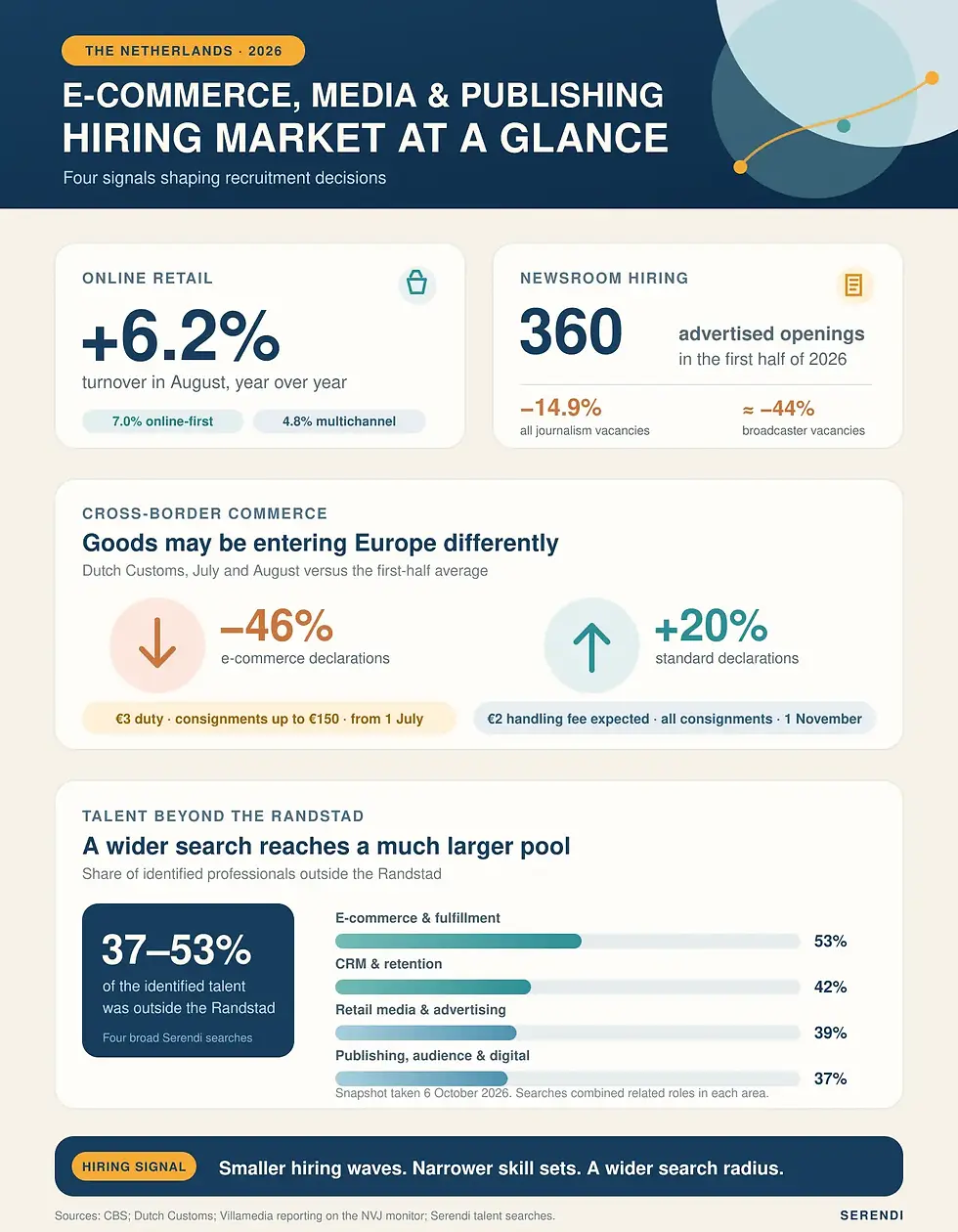
Dutch online retail turnover rose 6.2% in August 2026 from a year earlier. Online-first retailers grew 7.0%, compared with 4.8% for multichannel retailers. (CBS)
Cross-Border Costs and Fulfillment
Since 1 July 2026, consignments up to €150 from outside the EU get a €3 customs duty. A separate €2 handling fee will apply to all e-commerce consignments from 1 November, including those above €150. Sellers may need to revisit landed costs and fulfillment. (Dutch Customs; Dutch Customs)
Dutch Customs recorded 46% fewer e-commerce declarations in July and August than the first-half average, while standard declarations rose 20%. It sees an early shift toward bulk imports and EU warehousing. For the hiring side, see Serendi’s guide to logistics recruitment.
Media Hiring and Public Broadcasting
The journalism labor market tells an interesting story. There were just 360 advertised vacancies in the first half of 2026, down 14.9% year over year. Broadcaster vacancies fell nearly 44%, compared with 4.3% at publishers.
Full-time roles accounted for 51% of openings, but more hours did not necessarily bring more security: 46.5% of vacancies offered a fixed-term contract with no prospect of a permanent one. (Villamedia)
Public broadcasting may change further. A proposal under consultation would reorganize 11 broadcasting associations into four houses and combine NOS and NTR. If adopted, it would begin on 1 January 2029. (Government of the Netherlands)
For a wider analysis, read our article: The Dutch Talent Market: Availability, Shortages and Recruitment Insights.
Where Could Hiring Pressure Shift?
Cross-border commerce
More bulk imports and EU storage shift work toward customs, inventory planning, marketplace operations and fulfillment coordination.
Publishing and broadcasting
Lower vacancy volumes point to selective hiring. More full-time openings alongside many fixed-term contracts suggest employers are consolidating hours without adding broad permanent headcount.
Freelance engagements
The self-employed deduction fell from €2,470 in 2025 to €1,200 in 2026, and the plan is to go to €900 in 2027. Enforcement against false self-employment will resume. Companies should review long-running contractor arrangements and if their daily practice still matches the contract. (Business.gov.nl; NL Tax Administration)
Cybersecurity ownership
The Cyberbeveiligingswet, which implements NIS2, took effect on 15 August 2026. It adds risk-management and incident-reporting duties for more than 8,000 organizations. Retailers and publishers should check whether they fall within scope and whether they need help with setup or cybersecurity recruitment.
What Do the Talent Searches Reveal About Location?
Serendi ran four broad talent searches, combining related roles in each area. The results show how candidate-pool size and geography vary.
Search | Demand level | Median time in current role | Outside the Randstad |
E-commerce and fulfillment | Very high | 1.5 years | 53% |
CRM and retention | Very high | 1.9 years | 42% |
Retail media and advertising | High | 1.4 years | 39% |
Publishing, audience and digital | Very high | 3 years | 37% |
Across all four searches, 37% to 53% of professionals were outside Randstad.
How Can Hiring Teams Respond?
The market does not point to a broad hiring boom. E-commerce turnover is rising while spending per order is falling, journalism vacancies are down, and new rules are creating targeted needs. Many employers may face a few difficult specialist searches rather than steady hiring across departments.
Focusing only on Amsterdam, Rotterdam, The Hague and Utrecht can exclude a large share of available talent. If daily office attendance is not required, employers can recruit across the Netherlands. For English-speaking roles, they can also consider candidates in nearby EU countries.
This pattern can leave internal teams with a capacity gap: too few vacancies to justify hiring another permanent recruiter, but too many specialist searches for the existing team to manage during hiring peaks.
Serendi supports both small hiring waves and broader recruitment programs through its Recruitment as a Service model and tailored RPO solutions for the Netherlands.
Recruitment for Customer Support: Case Study
A remote-first BPO needed customer support hires in a new market while its local entity was being set up. It had no local recruiters, salary data, or candidate base. Serendi began with market research, then deployed a Project RPO team.
The first shortlist arrived in three workdays. Over three months, Serendi delivered 30 hires, averaging 10 workdays to hire, with 95%+ offer acceptance and a cost per hire of about €1,030.
Read the full customer support recruitment case study.
Plan for Fewer, Harder-to-Fill Roles
The Dutch market is moving in different directions. Online sales are growing, but order values and import economics are under pressure. Journalism vacancies are shrinking, and media employers are facing broadcasting reform and digital change. Contractor enforcement and cybersecurity rules add a new layer of responsibilities.
The common challenge is fewer roles with narrower, harder-to-find skill sets.
Serendi can support a small group of priority hires through Flex or build customized RPO Solutions when recruitment spans multiple teams, systems, or countries.
Talk to Serendi about the roles, markets, and recruitment capacity behind your next hiring plan.

About the author
Julia Koblischke is the Head of Talent Solutions at Serendi.
Julia has over 8 years of cross-industry, international experience in talent acquisition and account management, advising our clients globally. Her passion lies in transparent communication, connecting people with the right opportunities, and helping companies achieve growth and success.


